Latest News
News
Student Stories
Featured

Using alcohol to extract DNA in a biology class? No problem. Navigating a foreign health care system while traveling abroad with a chronic neurological condition? Manageable. Solving algebraic fractions? Tears.
Everyone has their kryptonite and for Northampton Community College (NCC) student Cheryl Morrison, it was almost intermediate algebra. Thanks to the encouragement of her professor, plus countless hours of tutoring, studying, and practicing problems, Morrison passed the class.
It just might be one her proudest accomplishments, which is saying something considering Morrison’s academic career at NCC has already included two study abroad experiences, presentations at the Northeast Regional Honors Conference, NCC’s Fall Academic Conference, developing a prototype for a health care advocacy app, and induction into Phi Theta Kappa, the international honor society for two-year colleges.
“I refused to give up,” says Morrison. “That [class] reminded me that persistence matters more than perfection and growth comes from perseverance, not getting everything right the first time.”
Morrison came to NCC seeking a career shift. She was working in childcare while raising her son, Archibald (“Archie”), but realized that her real passion was science, especially using science to help others.
With the encouragement of her husband, Calvin, she enrolled in the general studies program, which gives her flexibility to complete the prerequisite courses she’ll need to transfer into Moravian University’s neuroscience program.
Though Morrison came to NCC for the academics, she found a whole lot more.
“Returning to college as an adult has been one of the best decisions I’ve ever made,” she says. “NCC has prepared me academically while giving me the confidence to pursue opportunities I never imagined.”
Among those opportunities have been two faculty-led study abroad experiences to Thailand and Austria.
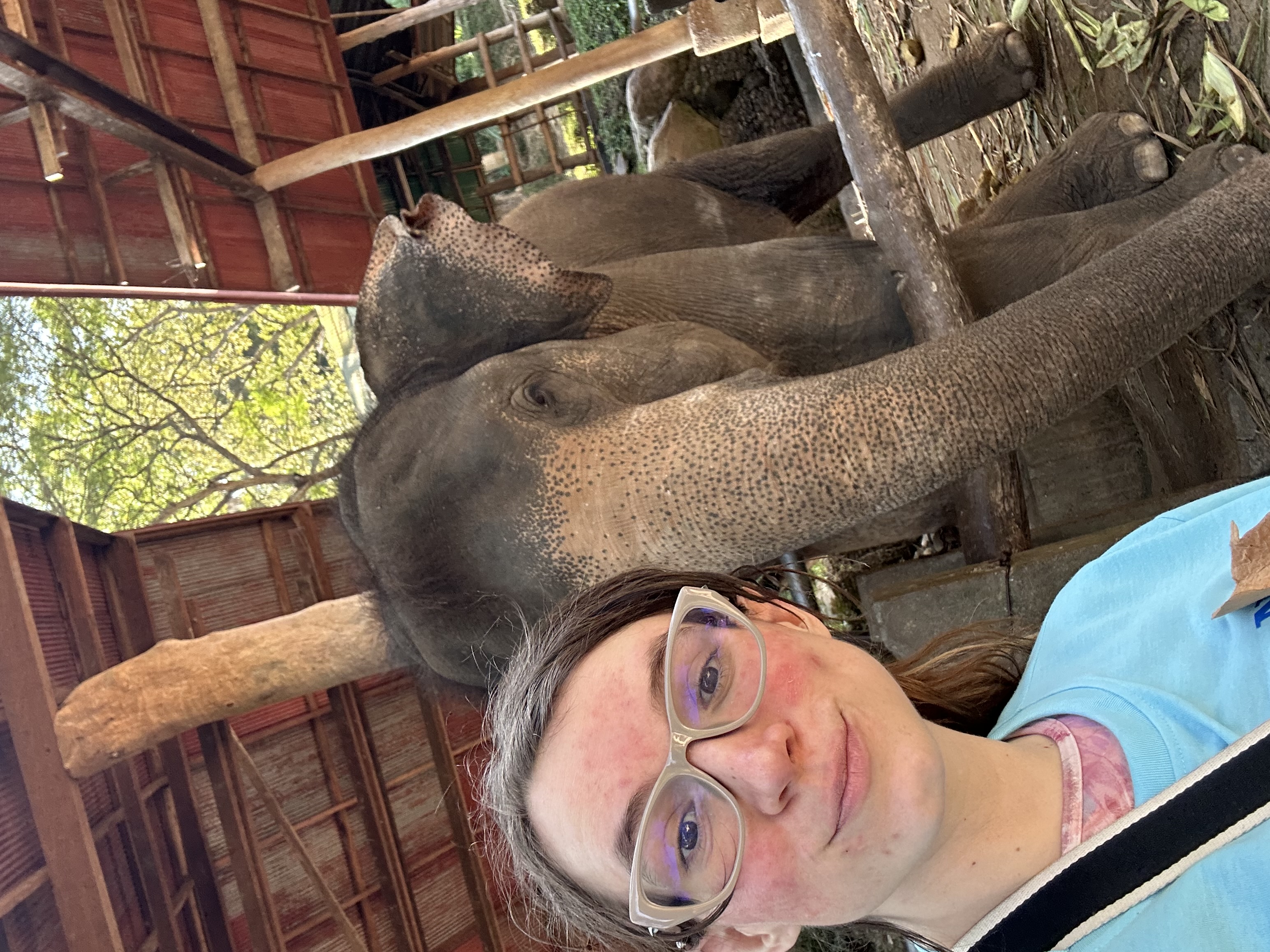
Morrison at rescue sanctuary in Thailand
In Thailand, Morrison helped transcribe historical Buddhist manuscripts, participated in an entrepreneurial program for which she developed the app prototype, worked with elephants at a rescue sanctuary, and even picked up some Thai. In Austria, she explored psychology and history and presented her research on the Shoah Wall of Names Memorial, which honors Austrian victims of the Holocaust.
The health care app, called Advocate, was a project close to Morrison’s heart—she experiences life with photosensitive epilepsy.
There have been times after seizures when Morrison has temporarily struggled to communicate. Those experiences made her recognize how vulnerable patients can be when they are unable to advocate for themselves, especially those facing medical emergencies alone.
Advocate is a platform that connects patients with trained support, such as nurses, social workers, medical assistants, transportation services, interpreters, and patient advocates so that they can navigate the health care system during their most vulnerable moments. The app can benefit anyone, not just those living with epilepsy.
“As an adult learner, I wanted to experience college beyond the classroom,” Morrison says. “[These experiences] reminded me that I belong in higher education. At NCC, I found an incredibly welcoming community and met other adult learners who understood the challenges of balancing school, family, and life.”
Morrison also credits her scholarships—she has received the Tuskes Family Scholarship and the Hollister Family Scholarship—with allowing her more financial freedom to pursue opportunities outside the classroom.
“These scholarships encouraged me to become more involved on campus, present research, and continue challenging myself academically,” she says. “I’m incredibly grateful to the donors for believing in students like me.”
Morrison’s long-term goal is to become a physician assistant and build a career that combines neuroscience, psychology, and compassionate, trauma-informed care.
In many ways, epilepsy has opened doors for Morrison. Curiosity about her own diagnosis led her to explore the science behind her condition and, in the process, develop a deep fascination with neuroscience. It also started a conversation with a professor from another college at the Northeast Regional Honors Conference in New Haven, Conn., this past spring. The professor thought Morrison’s work might lend itself to a children’s book.
She plans to take an introductory publishing class at NCC in the future and already has some ideas on crafting a story that will help kids with epilepsy feel seen while educating families.
It’s yet another opportunity, and Morrison isn’t going to pass it up.

Northampton Community College
3835 Green Pond Road
Bethlehem PA 18020
610.861.5300