Featured
Latest News
News
Alumni Spotlight

When Northampton Community College (NCC) alum James Laros ’82 gained a deeper understanding of himself later in life, many of his past experiences began to fall into place. His determination consistently outweighed his challenges, guiding him toward a lifetime of learning, achievement, and success.
Laros started at NCC in 1980 after finding high school challenging and full of cliques he didn’t fit into. During his time in high school, he said, “I lost interest. I focused on art, and I was a decent artist. Drawing didn’t require social interaction and was interesting to me.”
At the time, NCC offered a drafting and design technology major that seemed like a good fit. As a first-generation college student, he worked full time as a cook while attending classes.
Laros initially didn’t take his post-secondary education seriously. That changed after a nearly fatal car crash during a rainstorm. He was in the hospital for a few weeks, lucky to be alive after hydroplaning into a telephone pole.
The alum said this was a turning point for him to take school seriously. “This was the start of me really focusing. I was more interested, not taking anything for granted and doing the best I could,” he said.
Through his classes, Laros discovered his love of science. Draftsmen had to interact with engineers in scientific areas - physics, mechanics, thermal materials, fluid power, and more - to create blueprints. He didn't know it at the time, but that itch to learn more about science would remain throughout his life.
When Laros graduated, Computer Aided Design (CAD) had taken over the industry, and hand draftsmen were becoming obsolete. A year after graduating, Laros decided to go into the Air Force, following in his dad’s footsteps, as he decided his next steps. Through testing, he qualified to work in mainframe computers while in the military. He pursued additional classes at the University of Maryland, reinforcing electives in science, before his bachelor’s degree.
“The plan was to get my bachelor’s degree after the military, and the courses I took would transfer to a degree-granting institution.”
After five years in the military, where he met his wife, Laros moved to Colorado. He began work at Martin Marietta, now Lockhead Martin, on computer systems like the Cray-2 as a systems analyst for the Strategic Defense Initiative and continued taking classes.
After six years at Martin Marietta, he joined Sandia National Laboratories, an engineering laboratory. He completed his bachelor’s degree in computer science, graduating Cum Laude and earning the gray key for academic performance. Later, he completed his master’s degree in computer engineering.
In his now 37 years at the laboratories, Laros has focused on High Performance Computing for the National Nuclear Security Administration’s Advanced Simulation and Computing program. He currently leads various advanced architecture programs at Sandia and was recently appointed senior scientist, a role which only 2% of people lab wide achieve.
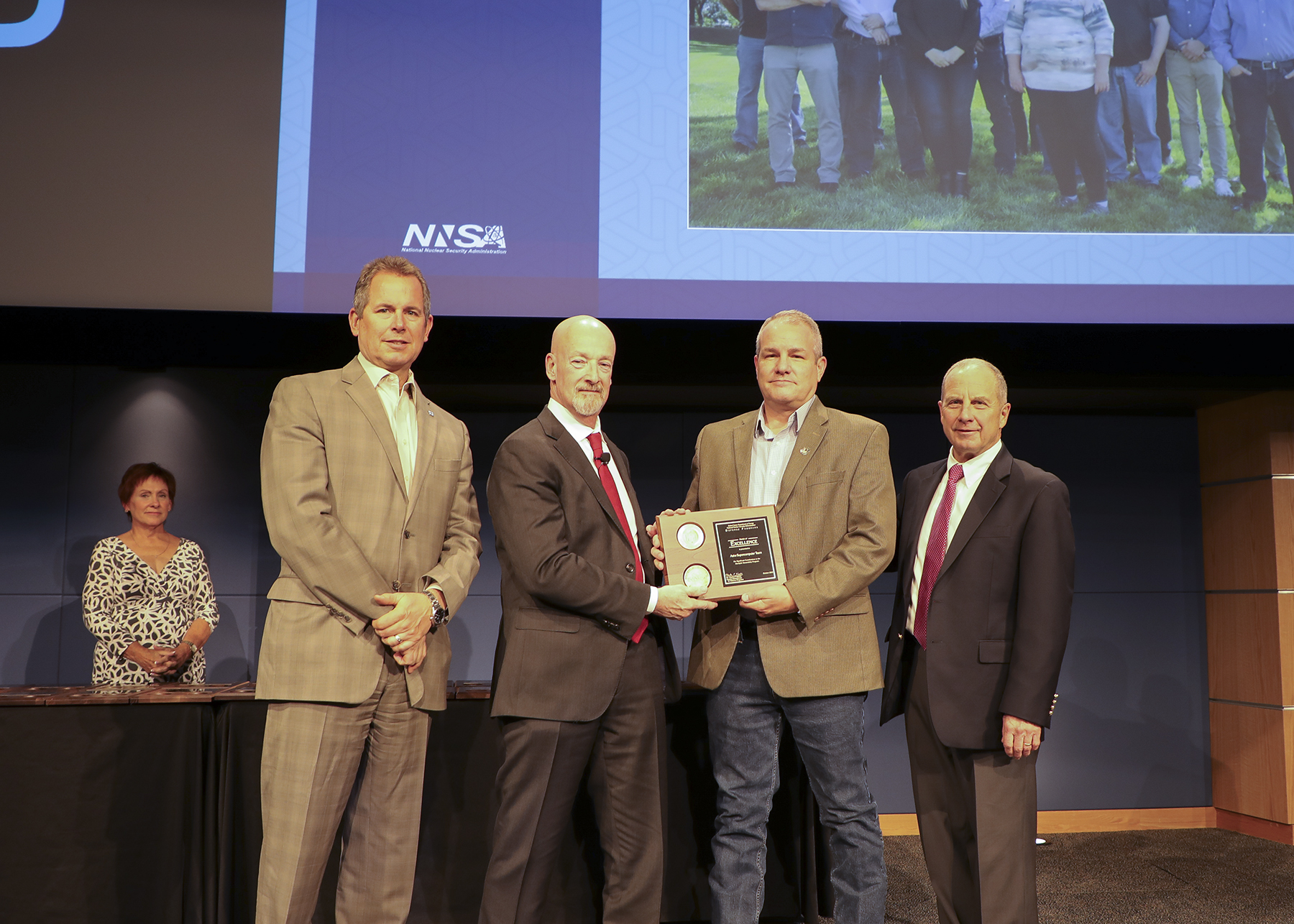
Laros receives award at DPA of Excellence Ceremony
The alum credits his NCC education with establishing his lifelong love of science and learning. “What I learned so long ago at NCC still helps me communicate with scientists and engineers from a wide range of disciplines.
Laros has published his expanded thesis on Energy Efficient High Performance Computing Measurement in Tuning, and working at a research organization has afforded him the opportunity to author dozens of peer-reviewed conference and journal publications as well as be awarded numerous national awards. Now, he’s writing an entirely different type of publication.
Now, Laros is writing a book with the therapist that initially diagnosed him with autism at the age of 60. During the pandemic, he was dealing with overwhelm and anxiety. His family urged him to see a therapist to cope with those feelings, and she saw something that no other practitioner had noticed to that point. “The book will be about my experiences and her assessment of why autistic people go through the things I've experienced,” Laros said.
After being diagnosed, past experiences started to make more sense to Laros. "Once I was diagnosed, I did a lot of research on autism. So many things past and present began to make more sense.” Current research suggests that neurotypical people go through a pruning of their synapses in their brain as they grow, but in autistic individuals, this pruning doesn’t happen. Because of this, he experiences extreme overstimulation from excessive input and stimuli, which results in overwhelming, sensory overload.
Looking back on his interactions with others, it answered a lot of unanswered “whys” like why he struggled in high school with a sense of belonging, why his non-verbal communication and social interaction can sometimes be strained, and why he was so thoroughly invested and hyper focused on the topics that interested him like science and computer science.
Laros said he’s learned to mask some of the things that bother people. "My wife will tell me what I’m doing that isn’t coming across the right way, and sometimes, I still don’t understand even when it’s explained. I just go and apologize because I don't mean any harm,” he says with sincerity.
Now, reflecting on his life, achievements, and his diagnosis, the alum says he’s incredibly grateful to NCC.
“This is where I started loving education. That format of learning is difficult for me, and now, I know why. But, NCC professors made it so that I was engrossed in what I was learning. The professors worked in the field, and they had excellent academic backgrounds. This was the best overall experience I had in my higher education career."

Northampton Community College
3835 Green Pond Road
Bethlehem PA 18020
610.861.5300